Test Weights and Calibration Weights
Test weights are reference masses of known value. When you place test weights on a scale or balance to compare the display with the weight's certified mass, a match can confirm the instrument’s accuracy. But a gap means it needs adjusting. This single check protects every measurement your business records—from a pallet in the warehouse to a sample on a laboratory bench.
Able Scale has supplied and serviced weighing equipment in Australia for 55 years. Our range runs from heavy industrial scales to laboratory balances, and we match test weights to each one. Tell us which scale or balance you use, and we will recommend weights that suit it.
Understanding Test Weight Classes
A weight class shows how close a weight's true mass is to its marked value. Each class sets a maximum permissible error (MPE), the largest deviation allowed. Two standards define the classes. OIML R111 is the international system. ASTM E617 is the North American system, with ten designations from 000 to 7. You may meet ASTM classes on imported instruments or in documents from an overseas parent company.
OIML R111 uses nine classes, from E1 to M3. The MPE is an absolute figure for each denomination, not a percentage. A 1 kg F1 weight may be out by no more than 5 mg. A 1 kg M1 weight may be out by 50 mg.
| OIML class |
MPE at 1 kg |
Typical use |
| E1 |
0.5 mg |
National and primary reference standards |
| E2 |
1.6 mg |
Calibrating other weights and fine analytical balances |
| F1 |
5 mg |
Routine testing of analytical and precision balances |
| F2 |
16 mg |
Precision checks with a wider tolerance |
| M1 |
50 mg |
Commercial and industrial weighing |
| M2 |
160 mg |
Platform scales |
| M3 |
500 mg |
Coarse and heavy weighing |
Two further classes (M1-2 and M2-3) apply only to weights between 50 kg and 5000 kg. The gap between E1 and M3 at 1 kg is a thousand-fold.
OIML R111 also fixes a density requirement for each class. This is why high-accuracy weights need a tightly controlled alloy. Every class traces back to the SI kilogram.
That unit has been defined by fixing the Planck constant since 20 May 2019. National institutes realise it, and accredited laboratories pass it down to the weights on your bench.
Good to know: Most references place OIML E2 close to ASTM Class 1—but pair with care. Always pick the system your regulator or customer specifies, then choose the class.
How to Choose the Right Weights for Scales
Here are five checks that narrow the choice:
Capacity and test loads: A scale that weighs 50 kg cartons needs a check near 50 kg—not only a small weight at the bottom of its range. This means you need to choose weights that cover the loads you weigh every day. Many manufacturers suggest a weight of at least one third of the scale's maximum capacity when you adjust a scale.
Readability and accuracy: When the reading is fine, then go for a tighter class. An analytical balance reading to 0.1 mg uses E2 or F1 weights. A platform scale uses M1 or M2.
Class and permissible error: When you are testing, the weight's error limit must be relative to the tolerance. OIML R111 has a rule here— a weight's calibration uncertainty must not exceed one-third of its class limit. That explains why an E2 weight calibrates an analytical balance.
Material and handling: Stainless steel(grade 316) is best for laboratories and clean areas as it resists humidity and chemicals. In a warehouse, cast iron is useful with heavy loads and for rough use. Just pick a shape that is right for your pan or hook.
Certificates and traceability: A certificate links the weight to national standards through comparisons. An ISO/IEC 17025 accredited certificate reports measurement uncertainty, which GMP and GLP laboratories require. Ask your auditor which level applies before you buy.
The class sets the weight's accuracy when new. It does not set how often you recalibrate. That interval depends on how often you use the weights, where you store them, and what your quality system demands.
Applications of Test Weights
Test weights keep daily weighing honest. Staff place a known mass on the scale at the start of a shift, and any drift shows up before it affects stock, orders, or product.
| Sector |
Practical check |
| Manufacturing |
Test a bench scale used for batch mixing before each run |
| Warehousing |
Check a platform scale used for stock control with weights close to its normal load |
| Logistics |
Confirm a pallet or parcel scale reads correctly before freight is charged by weight |
| Food processing |
Verify portioning scales at shift start and record the result for audits |
| Retail |
Test a deli or produce scale so customers pay for the weight they receive |
| Laboratory |
Verify an analytical balance with E2 or F1 weights before critical measurements |
Imagine a storeperson putting a 20 kg weight right in the middle of a platform scale, then moving it towards each corner. If the number on the display changes noticeably, something’s not right — it could be the load cells or the platform itself.
A scale can look perfectly accurate when the load sits in the centre, but start giving different readings once a pallet is placed off to one side. Without that simple corner test, you might never spot the problem.
Labs handle things differently. Before using an analytical balance, a technician will test it with a weight close to the mass they normally measure. They note the result and only start work if it falls within the acceptable range.
It’s easy to mix these up, but they’re really three different things.
|
A routine check is exactly what it sounds like — a quick sanity check. You place a known weight on the scale, see whether the reading matches, and leave it at that. Nothing gets adjusted.
Calibration goes further. A technician uses a certified, traceable weight to fine-tune the instrument, then documents the adjustment. It’s a proper process, not just a glance at the display.
Verification is about legal compliance. In Australia, any scale used for trade has to be verified by a licensed certifier or inspector. They test it with standard weights and follow the National Measurement Institute’s rules.
One thing worth remembering: a verified scale isn’t automatically an accredited calibration, and having a scale calibrated doesn’t make it legally verified for trade. They might sound similar, but they do very different jobs.
|
Why Choose Able Scale for Test Weights?
Able Scale is the largest independent weighing company in Australia, with 55 years in the industry. Our range spans laboratory balances to vehicle weighing systems, so we understand the instrument your weights will be tested on. We also repair and calibrate scales, and we hire them out.
Clients tell us the same thing about our service. Dench Fine Foods has hired and bought equipment from us for 30 years, and Bertocchi Smallgoods credits our support with keeping downtime low. Call 1300 731 360 or visit our Thomastown showroom, and we will help you find the right weights.
FAQs
1. What are test weights used for?
Test weights are used for checking if a scale or balance is reading correctly. You can place a weight of known mass on the instrument and compare the display with the marked value. Businesses use these test weights for daily checks and to confirm accuracy after a scale is moved or repaired.
2. What is the difference between test weights and calibration weights?
The terms overlap and are used interchangeably. But "Test weight" describes any reference mass that checks a scale. "Calibration weight" refers to a certified weight that adjusts an instrument or calibrates other weights.
3. What are the different classes of test weights?
OIML R111 defines nine classes: E1, E2, F1, F2, M1, M1-2, M2, M2-3 and M3. E classes serve reference work, F classes serve precision balances, and M classes serve industrial and trade scales. ASTM E617 uses classes 000 to 7.
4. How do I choose the right weights for scales?
You can match the weight to your scale's capacity and accuracy needs. Make sure to pick a class that limits error when compared to your scale's tolerance. Also, check that the material suits your environment, and confirm whether you need a certificate. Our team is here to review your model and recommend.
5. Which test weights are suitable for industrial scales?
Many industrial platform and floor scales use M1 or M2 weights made of cast iron for heavy loads. Bench scales with finer readability may need F2 or M1 stainless steel weights. The right choice depends on your scale's capacity and readability.
6. Do calibration weights need a certificate?
It is not always required. A routine check needs only a weight of known class. Formal calibration and audits require a certificate showing traceability to national standards. An ISO/IEC 17025 accredited certificate also states measurement uncertainty.
7. How should test weights be stored and maintained?
You should always keep weights in their case - in a dry, stable spot. When picking them up, make sure you use gloves or forceps, never bare hands, and keep them clean. Also, dust or rust tends to change mass. We suggest yearly recalibration on a schedule set by use and environment.
Not sure which weights suit your scale? Contact our team today



 Call us Today

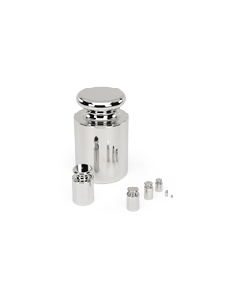 Test Weights & Masses - Class 1 Stainless Steel MassesWe have a full range of stainless steel test weights, from 1mg to 20kg.
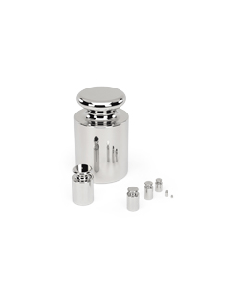 Test Weights & Masses - Class 2 Stainless Steel MassesWe have a full range of Class 2/OIML M1 test weights, from 1mg to 20kg. Blog...From $49.50
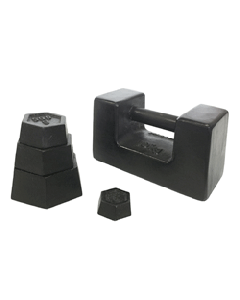 Test Weights & Masses - Class 3 Cast Iron MassesWe have a full range of cast iron test weights, from 100g to 20kg, and...From $30.80


