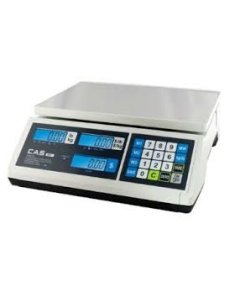
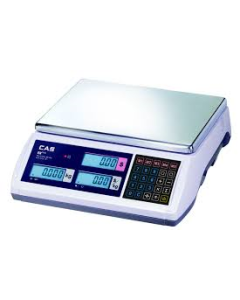
A miscalculated total at the counter costs you more than a few cents. It can affect a customer's confidence in the transaction. Price computing scales reduce that risk — weighing, pricing and totalling in one motion, so your team never reaches for a calculator mid-transaction.
A price computing scale is a digital weighing instrument that calculates a product's selling price based on its measured weight. The operator enters a price per kilogram or another unit, and the scale multiplies that figure by the weight to display the total. Many models add tare, PLU memory, and a customer-facing screen.
|
Step 2: Measure the weight. The scale reads the load and displays it digitally.
|
|
Step 3: Enter the unit price. Manually, or pulled from stored PLU memory for regular products.
|
|
Step 4: Calculate the total. The scale multiplies the weight by the unit price to show the amount owed.
|
"Worked example: 1.5 kg at $8/kg = $12.00 — the customer sees the same number the operator does, at the same time."
Benefits of Price Computing Scales for Retail Businesses
Faster price calculation
The total appears as soon as weighing and pricing are done, which keeps queues moving during busy periods.
Improved pricing accuracy
Manual entry errors happen. Once the unit price is set correctly, the scale performs the multiplication consistently, every time.
Easier customer transactions
A display showing weight, unit price and total side by side gives customers something to follow, rather than a number to take on trust.
Efficient retail weighing
Weighing, pricing and, on selected models, printing sit in one unit — useful when counter space is tight.
Flexible operation
Bench and pole-display models suit different layouts, and battery-capable scales extend the same functionality to markets and mobile stalls without mains power.
Not sure which capacity suits your counter? Talk to our team.
Choosing the Right Retail Price Computing Scale
Consider the maximum capacity
Choose a scale that comfortably handles your heaviest routine item. A produce counter might suit a compact 6–15 kg model; heavier goods need a larger platform.
Consider readability
Readability is the smallest increment the scale displays. Small-quantity items generally need finer readability than bulkier, lower-value goods.
Check trade approval requirements
If the customer pays based on measured weight, the scale needs NMI trade approval and verification.
Choose the right display
Bench models suit compact counters. Pole displays improve visibility where the customer stands opposite staff, and dual displays support pricing transparency.
Consider battery operation
Battery-capable models work well for markets, mobile stalls, and locations without easy power access. Check runtime and charging method.
Consider PLU and printing functions
PLU memory stores regular products for quicker entry. If you need labels or barcodes, look for a model built specifically for label printing.
Trade-Approved Price Computing Scales in Australia
In Australia, the National Measurement Institute assesses and approves the design of weighing instruments used for trade. Approval confirms the design meets technical requirements — it doesn't confirm the individual unit on your counter is verified.
|
Before you buy: "Commercial" and "digital" aren't the same as trade-approved. Confirm the model's NMI approval reference and check that your specific unit has been verified by an authorised licensee. Certain repairs or modifications may mean you need to verify the unit again.
|
Need help confirming NMI approval for your setup? Ask our team.
Why Buy Price Computing Scales from Able Scale?
Able Scale has supplied Australian retailers with weighing equipment for 55 years. Multiple brands and trade-approved options give you a range of capacities to match different counters. Beyond the sale, our team provides technical support, calibration, servicing, and replacement parts Australia-wide.
FAQs
What is a price computing scale?
A digital scale that weighs a product, applies a stored or entered unit price, and calculates the total. Common in produce, deli, meat, and bulk-goods retail.
How does a price computing scale calculate the total price?
It multiplies the measured weight by the entered unit price. For example, 2 kg at $6/kg comes to $12, with tare applied first if needed.
Do price computing scales need to be trade-approved in Australia?
Yes, whenever the measured weight determines what the customer pays. Confirm NMI approval and verification before commercial use.
What capacity price computing scale do I need?
Enough to cover your heaviest regular item comfortably, with readability suited to your lightest products. Our team can help match capacity to your range.
Can price computing scales print labels?
Some models can, though not all. Choose a scale built specifically for label printing if barcodes or ingredient lists are required.
What is the difference between a price computing scale and a weighing scale?
A standard scale measures and displays weight only. A price-computing scale also applies a unit price and calculates the total, making it well-suited to retail transactions.
Can price computing scales store product prices?
Many use PLU memory to store regular products. The number of slots and how prices update varies between models.
What are PLUs on a price computing scale?
PLU stands for "price look-up" — a stored entry with an item name and unit price, letting staff select a product instead of re-entering the price.
Can a price computing scale connect to a POS system?
Some models offer POS or ECR connectivity; others run independently. Check available ports and software compatibility before assuming integration works.
Can price computing scales run on batteries?
Selected models support battery operation, useful for markets and temporary stalls. Check battery type, charging time, and runtime before ordering.
Compare trade-approved price computing scales from CAS, Ishida, Nuweigh, and Ohaus — contact Able Scale.



 Call us Today
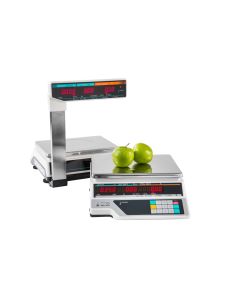 Price Computing Scale- Ishida INSA compact retail scale with or without pole display up to 15kg.From $630.00
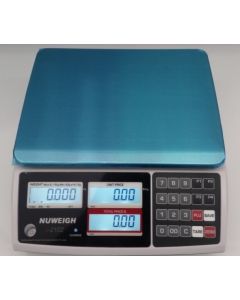 Price Computing Scale Battery Op. - Nuweigh J2102A dual range price computing scale, with or without pole display.From $645.00