

 Call us Today


“When the reading is wrong, everything goes wrong”
A forklift driver lifts a pallet weighing 800kg, expecting the floor scale under it to read right. But the scale reads 740kg because nobody's checked the calibration in a long time. The driver doesn't know the load is heavier than what the system says. Neither does the truck waiting to take it.
This is how heavy-duty weighing fails. When paperwork lies about weight, everything goes wrong. Operators end up lifting overloaded loads that can tip a forklift over or blow the hydraulics. It creates a total mess during audits because the numbers don't add up. What is more, even managers are confounded and can't explain the discrepancy.
Heavy-duty scales are necessary for safety, productivity, inventory accuracy, compliance, and equipment lifespan, and getting the weight wrong compromises every one of those. Crane scales, floor scales, and pallet jack scales all solve different problems.
The wrong scale costs more than the right one. See Able Scale's full range of heavy-duty scales and find the fit for your operation.
|
Human error is responsible for 80% of failures and defects in manufacturing, according to LabServe’s cited expert commentary. |
Why Choosing the Right Heavy-Duty Industrial Scale Matters
Choosing the wrong scale means accommodating wrong consequences, and here is why it matters:
Accuracy matters more at scale. A small error on a small weight may not matter much, but the same percentage error on a 2-tonne load is a real number. It can overload the equipment or cause a shortfall for a customer.
Load capacity is closely tied to this—a scale running near its limit every day wears out faster and drifts out of calibration sooner; that is why investing in more headroom yields a better payoff than investing in just capacity.
Durability is very important in industrial environments. Forklifts almost always crash into floor scales, and crane scales swing violently. Because of this, industrial scales must be built to survive impact, not just calculate weight.
Safety follows the same logic—an inaccurate reading on a heavy crane lift is a physical hazard.
Trade compliance is non-negotiable. If weight sets a price, the scale needs the right certification. Wherever weight determines a price or feeds into a commercial transaction, trade compliance becomes inevitable.
Reduced downtime, lower maintenance, and better inventory control aren't separate benefits. Addressing all of the above at the point of purchase allows these benefits to follow automatically.
|
A food manufacturer packing 10,000 bags a day with a scale 50g over target gives away 500kg of product daily — 125,000kg a year. |
Types of Heavy-Duty Industrial Scales
No single scale covers every job, so here are three categories that do most of the work.
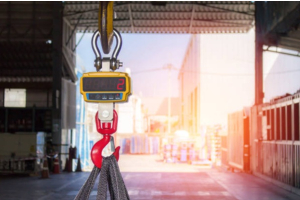
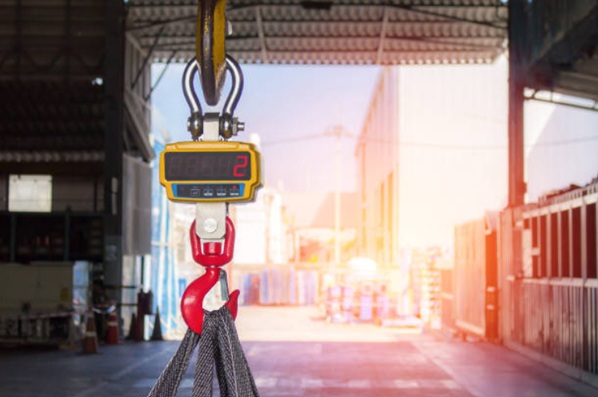
Crane scales hang from a crane or hoist and weigh loads mid-lift — the natural choice for steel yards, scrap metal facilities, and construction sites where loads are too large or awkward for a platform. The lift and the weigh-in happen in the same motion.
Platform and floor scales sit on the ground and handle pallets, drums, crates, and containers driven onto them. A well-built floor scale can handle continuous forklift traffic and still be accurate.
Pallet jack scales integrate weighing directly into the jack. Goods are weighed as they move and do not require a separate station. By removing this seemingly small extra step, you can instantly gain back hundreds of hours of productivity and lower labour costs.
|
Scale Type |
Best For |
Key Benefit |
|
Crane Scale |
Steel, scrap, construction |
Weigh suspended loads |
|
Platform/Floor Scale |
Warehouses, factories |
Handles heavy pallets & containers |
|
Pallet Jack Scale |
Warehousing, logistics |
Weighs while transporting loads |
Best Heavy-Duty Industrial Scales
CAS Heavy Duty Crane Scale (Caston-II) is built for demanding overhead lifting environments. It is used in heavy, irregular lifts in construction and scrap metal applications for exceptional accuracy.
CAS Heavy Duty Crane Scale (Caston-III) builds on the same crane-rated reliability with additional data handling for operations that need to track volumes across multiple lifts. This is not just for individual readings.
Painted Steel Pallet Scales - Nuweigh IH1949P is a steel-built floor scale designed for constant forklift traffic. It promises uncompromising accuracy and is the right choice for high-volume warehouse floors.
Nuweigh YAH494 Pallet Jack Scale integrates weighing into the handling process. There is no need for a separate station, as it keeps data accurate as goods move through the facility.
Which Heavy-Duty Scale Is Best for Your Industry?
|
Industry |
Recommended Scale |
Why |
|
Warehousing & Distribution |
Nuweigh IH1949P Pallet Scale |
Takes daily forklift traffic without losing accuracy |
|
Logistics & Freight Receiving |
Nuweigh YAH494 Pallet Jack Scale |
Weigh goods while they're moved — no extra step |
|
Construction & Steel Fabrication |
CAS Caston-II Crane Scale |
Accurate overhead weighing for heavy, irregular loads |
|
Scrap Metal & Recycling |
CAS Caston-III Crane Scale |
Crane-rated durability plus data tracking for volume |
|
Manufacturing |
Nuweigh IH1949P Pallet Scale |
Reliable floor weighing for materials and finished goods |
Choosing the Right Heavy-Duty Scale for Your Operation
A few technical factors determine which scale will suit your operations:
Maximum and typical load weight. Match the scale to your heaviest load, then add headroom. A scale running at its ceiling every day won't stay accurate for long.
Platform dimensions relative to load size. A platform too small for your pallet means overhang. Overhang means instability, which will lead to a bad reading. Measure the load, not just the weight.
Environmental conditions. Environmental conditions vary widely in different industries. Outdoor sites, washdown areas, dusty warehouses — each needs different protection. Stainless steel and a higher IP rating cost more now and save money later.
Legal-for-trade requirements. If the weight sets a price, the certification isn't optional.
Connectivity preferences. Connectivity also needs to be decided upfront — whether the scale needs to feed a WMS, print labels, or export records. Adding it later costs more than buying it in from day one.
Portability requirements. You should go with one site, one load profile. Multiple sites or shifting needs — go portable or jack-integrated.
Not sure where your operation sits across these criteria? Get in touch with Able Scale — a five-minute conversation usually narrows it down to one or two options.
FAQs — Heavy Duty Scales
1. What capacity and platform size do I need for pallet weighing?
Standard pallets fit most standard floor scale capacities. Oversized or stacked loads need a bigger platform and a capacity rating well above your typical maximum.
2. Can heavy-duty scales be used outdoors year-round?
Yes, if the scale is rated for it. Check the IP rating and weatherproof housing before you rely on it through a wet season.
3. How often should a heavy-duty scale be calibrated?
At least annually for most heavy-duty scales. More often, if the volume is high or the weight feeds into a trade transaction.
4. Can heavy-duty scales integrate with my existing ERP or WMS?
Most modern scales do, via USB, Ethernet, or wireless. Confirm compatibility before you buy, not after.
5. How do I know if my heavy-duty scale needs to be trade-approved?
If the weight determines a price or appears on an invoice, it needs trade approval. If you're not sure, ask before an auditor asks for you.
Conclusion
There's no single best heavy-duty scale, but there's always the right scale that you would need for what, where, and how often you weigh. A crane scale won't help a warehouse move pallets all day. Matching the scale to the job is the right option.
Able Scale stocks heavy-duty crane, platform, and pallet jack scales built for Australian conditions, with local support and calibration behind them. Get in touch with our team or browse the full range of industrial scales to find what fits your operation.