We have a range of medical scales that are suitable for personal and medical use and can be also used at home or at gyms, health centres, hospitals, and nursing homes. Our medical weighing equipment range includes baby and chair scales plus personal weighers, measuring equipment and more.
Whether your business requires baby or chair scales or other measuring equipment, we have an efficient solution for you.
Accurate Medical Scales for Hospitals, Clinics & Healthcare Facilities
Medical scales are precision devices used in hospitals, clinics, and healthcare facilities to measure patient weight for diagnosis and treatment. Able Scale supplies a wide range of medical weighing scales for use in portable clinical units and heavy-duty ward platforms. These medical scales are engineered for repeatable accuracy in Australian healthcare settings. We stock solutions for every clinical environment—from GP clinics and aged care facilities to rehabilitation centres and neonatal units,
Able Scale’s medical scales have high-precision weighing technology. They are designed for clinical and healthcare environments.
Our units feature easy-to-read digital displays that reduce reading errors and heavy-duty construction built for daily use. We stock options for bariatric patients and those with limited mobility, so no patient is left without an accurate, comfortable weighing solution.
You can choose from our portable and fixed models. We provide calibration and servicing support, nationwide delivery, and expert advice to keep your equipment accurate and compliant.
Our Range of Medical Scales
Choosing the right medical scale comes down to your patient population and clinical setting. Able Scale stocks five key types.
Personal Scales Standard personal scales are the most widely used option in GP clinics and general health assessments. They are compact and straightforward and handle routine patient weighing quickly.
Bariatric Scales Bariatric scales are designed for patients with higher body weights. These medical weighing scales come with extended weight capacities that standard models cannot accommodate. They're commonly used in obesity clinics and any facility committed to inclusive patient care.
Chair Scales Chair scales weigh patients while they are seated. With these scales, patients don’t need to stand unaided. They're well-suited to aged care facilities, dialysis centres and rehabilitation settings where standing for any length of time may not be safe or comfortable.
Wheelchair Scales Wheelchair scales weigh the patient and their wheelchair together, then subtract the chair's tare weight for an accurate patient reading. They're essential in disability support services and rehabilitation centres.
Baby Scales Baby scales are calibrated for the sensitivity required in neonatal and paediatric care. These health scales are used in neonatal units, maternal health clinics, and paediatric practices. They provide the fine-resolution readings to track infant growth.
Accuracy, Calibration & Compliance
We need accurate patient weight to calculate medication dosages and track recovery. This means inaccurate readings have direct clinical consequences. When we regularly calibrate medical scales, they perform to specification. Calibration reduces the risk of measurement drift and helps facilities meet the accuracy standards expected in professional healthcare.
Able Scale offers calibration services, technical support, and ongoing maintenance assistance for your equipment so your scales remain compliant. Our team can help your scales remain accurate and fit for clinical use whenever you require a scheduled service or a one-off check.
Q2. What type of medical scale do I need for a small clinic?
Most small clinics and GP practices need a standard personal or digital medical scale. These scales do not take up much floor space and weigh accurately.
Q3. How accurate are medical scales?
Quality medical scales offer high-precision measurements with minimal variance. Accuracy is maintained through regular calibration.
Q4. Do medical scales require calibration?
Yes. Regular calibration helps your scales to produce consistent, reliable readings.
Q5. What is a bariatric scale?
A bariatric scale comes with an extended weight capacity. It is designed for patients whose weight exceeds the range of standard models.
Q6. What is the difference between a wheelchair scale and a chair scale?
Wheelchair scales weigh a patient while they remain seated in their wheelchair. They use the tare functionality to isolate the patient's weight. Chair scales weigh seated patients directly using a built-in chair. It doesn't have to accommodate a separate wheelchair.
Q7. Can medical scales be used in aged care facilities?
Yes. Chair scales and wheelchair scales are best for aged care, where standing while weighing may not always be practical for residents.
Q8. Do medical scales come with BMI or height measurement?
Many digital medical scales come with BMI calculation as a standard feature. Some models also support optional height rods for height measurement.
Q9. Are digital medical scales better than mechanical ones?
Digital scales are usually more accurate and offer clearer readouts. They also offer additional features such as BMI tracking. For most clinical settings, digital is the preferred choice.
Largest independent weighing company in Australia.



 Call us Today

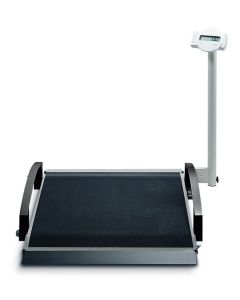 Seca Wheel Chair Scale (SE664)A high capacity scale, up to 360kg for weighing heavy patients.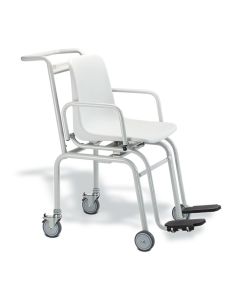
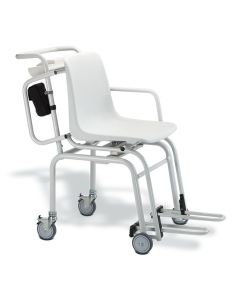 Seca Electronic Chair Scale (SE954)A mobile chair scale constructed from a sturdy circular steel tube frame.
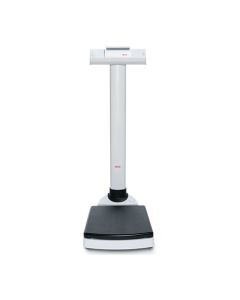 Seca Electronic Personal Scale (SE703)A high capacity scale up to 250kg, with column mounted display.
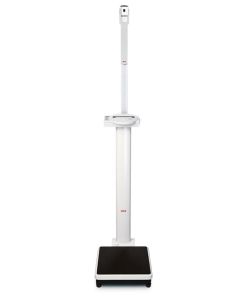 Seca Electronic Personal Scale (SE769)A versatile, low maintenance personal scale up to 200kg capacity.


